

India’s $64.7-Billion Reserve Retreat: Foreign Investor Flight and a Political Test for Modi

October 26, 2026
By TN Ashok I New York
youtube.com/@theflagpost.in

India’s foreign-exchange reserves have fallen by approximately $64.7 billion in six weeks, from a record $785.706 billion on September 4 to $721.016 billion for the week ended October 16, according to the Reserve Bank of India (RBI). The sudden reversal raises a fundamental question: is this temporary currency management, a deterioration in capital flows, or a warning that international confidence in the Indian economy is weakening?
India, until recently projected to grow at around 7.5%, compared with global growth of approximately 3.3%, is facing mounting financial pressures. But the evidence must be separated from speculation about their political implications.
An exceptional peak, followed by a sharp reversal The September record was partly driven by a special concessional dollar-rupee swap facility associated with non-resident Indian deposits under the FCNR(B) programme. Banks reportedly raised approximately $127.2 billion through the window by August 31, contributing to a $44.9 billion weekly jump in reserves before the programme closed.
Under the arrangement, banks obtained rupees against dollar deposits, while the RBI received dollars and undertook to return them at a predetermined exchange rate when the swaps matured. The facility provided immediate dollar liquidity and helped counter pressure on the rupee, but also created future obligations.
Consequently, the record reserve figure did not necessarily represent a permanent increase in India’s underlying capacity to earn foreign exchange. The subsequent decline cannot simply be interpreted as $64.7 billion fleeing the country.
For the week ended October 16, foreign-currency assets stood at $591.847 billion, down $5.758 billion during the week, while gold holdings rose by $706 million to $105.8 billion. The wider decline reflects foreign-currency movements, RBI intervention and valuation effects.
Foreign investors retreat as markets weaken Foreign portfolio investors (FPIs) have emerged as an important source of pressure. They reportedly withdrew ₹35,861 crore from Indian equities in September and another ₹44,166 crore during early October. Their net equity outflows for 2026 had exceeded ₹3 lakh crore by October 11, with another report putting October withdrawals at approximately ₹52,100 crore.
Higher US Treasury yields, a strengthening dollar, expensive crude oil and attractive investment opportunities elsewhere have encouraged global investors to reconsider their Indian exposure
The consequences are visible in the stock market. On October 23, the BSE Sensex closed at 73,123.83 and the Nifty 50 at approximately 22,600. During the week, the Nifty Midcap index fell 5.6% and the Smallcap index plunged 7.3%, their worst weekly performances in around 20 months.
BSE-listed companies reportedly lost approximately ₹16.1 lakh crore in market capitalisation, with aggregate value falling from ₹467.9 lakh crore to ₹451.8 lakh crore.
These losses represent declining market valuations, not an equivalent amount of money physically leaving India. Nevertheless, widespread selling raises questions about corporate earnings, expensive valuations and investors’ willingness to pay for future growth.
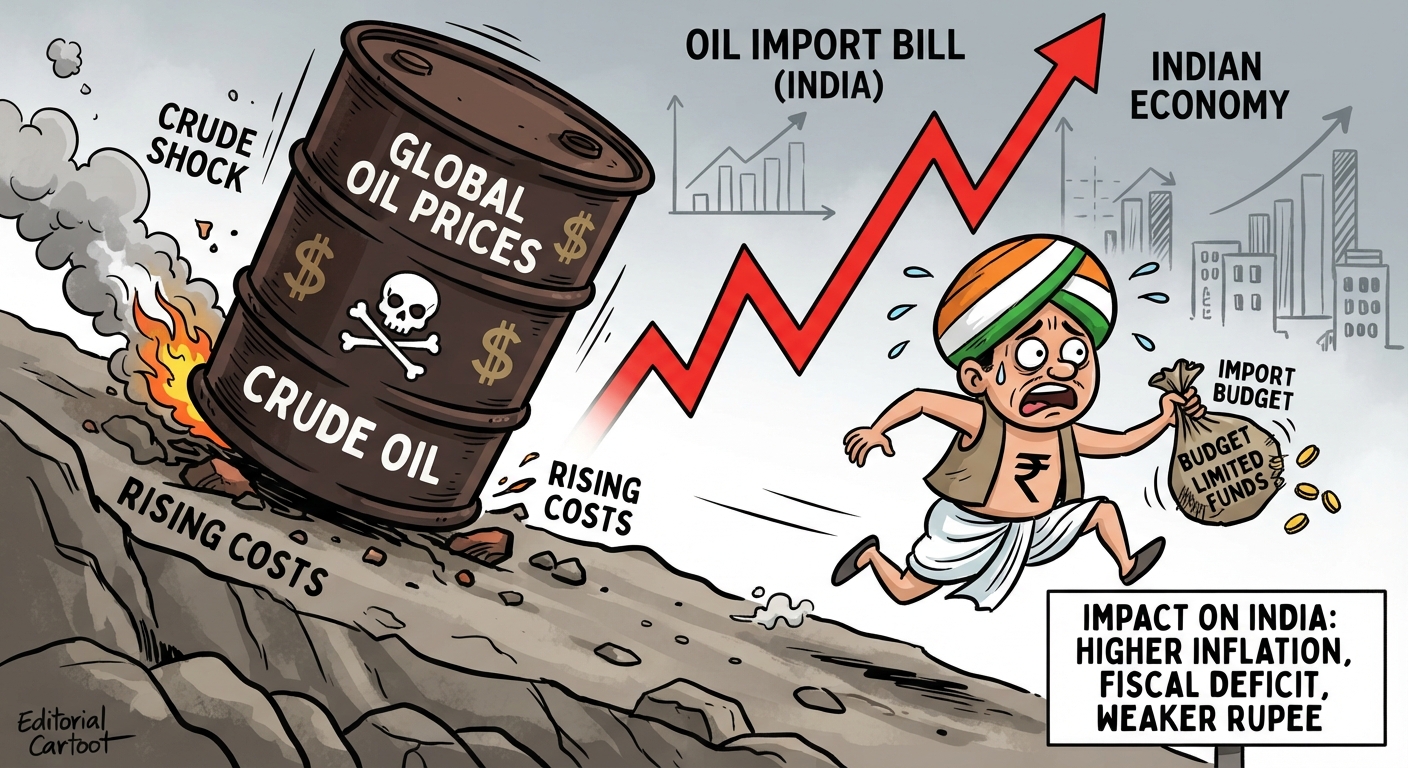
Oil and the rupee compound thepressure Brent crude rose above $114 a barrel on October 23 amid fears of supply disruptions. For an economy heavily dependent on imported oil, higher prices increase the dollar cost of imports, threaten corporate profit margins and risk widening the current-account deficit.
The rupee closed at approximately ₹94.95 to the dollar on October 23, compared with ₹87.82 a year earlier, representing depreciation of roughly 8.1%. It had approached ₹96.8 earlier in October.
A weaker rupee makes imports, overseas education, travel and foreign-currency debt servicing more expensive, although exporters and recipients of dollar earnings may benefit.
The RBI has sold dollars to moderate the currency’s decline. Such intervention supplies dollars to the market but reduces reserves. It can smooth volatility; it cannot indefinitely counter a persistent imbalance between dollar demand and supply.
FDI and remittances: unanswered questions Foreign direct investment (FDI) and overseas remittances also matter. A sustained slowdown in net FDI could weaken productive investment and signal concerns about future returns. Remittances provide an important source of foreign exchange.
However, weekly reserve data alone cannot establish that either FDI or remittances has suddenly weakened enough to explain the decline. Net FDI depends on inflows, divestments, profit repatriation and outward investment. Remittances must also be distinguished from the special deposit-swap arrangement that helped lift reserves.
The strongest documented explanations remain portfolio selling, RBI intervention, oil-price pressures and valuation changes.
Political uncertainty and investor confidence The economic reversal coincides with controversy surrounding Chief Election Commissioner Gyanesh Kumar. An Indian Express investigation reported 14 formal objections by two Election Commissioners over ten months concerning decisions and procedures, including electoral-roll revisions affecting approximately 13 crore voter names.
The allegations have fuelled student protests demanding Kumar’s resignation. Opposition groups argue that eligible voters risk disenfranchisement; the Election Commission maintains that revisions seek to remove duplicate, deceased, relocated and otherwise ineligible entries.
UN experts have called for an impartial investigation into alleged excessive force against protesters. The government has rejected external criticism as interference in India’s internal affairs. Reports questioning the protesters’ nationality and sources of funding remain allegations requiring evidence, not established explanations.
Political instability and concerns about institutional independence can influence long-term investment decisions. Yet there is no quantified evidence demonstrating that the electoral controversy caused the reserve decline. Its timing may be significant, but coincidence is not causation.
Finance Minister Nirmala Sitharaman has argued that India’s markets remain liquid, that investors’ ability to exit reflects market depth, and that global dollar strength—not simply rupee weakness—is driving pressure. She has also emphasised the country’s macroeconomic buffers and the risks posed by fuel, fertiliser and foreign exchange.
A warning, not yet a crisis At $721 billion, India retains a substantial reserve cushion. But the speed of the $64.7 billion reversal demands attention. The challenge is to preserve external resilience while attracting durable investment, improving export competitiveness and reducing vulnerability to imported energy.
The decisive question is whether India can sustain foreign-exchange earnings and investor confidence without relying continually on central-bank intervention. The reserve decline is a warning signal, not proof of crisis. Its significance will depend on whether capital flows stabilise, the rupee finds greater resilience and economic fundamentals withstand mounting global and domestic pressures.
